
Meet me in Seattle
Knowing your own position is not enough. In this short article we explain how the Settle Chart works and how you can use Opponent Values to identify the shared Settlement Position.
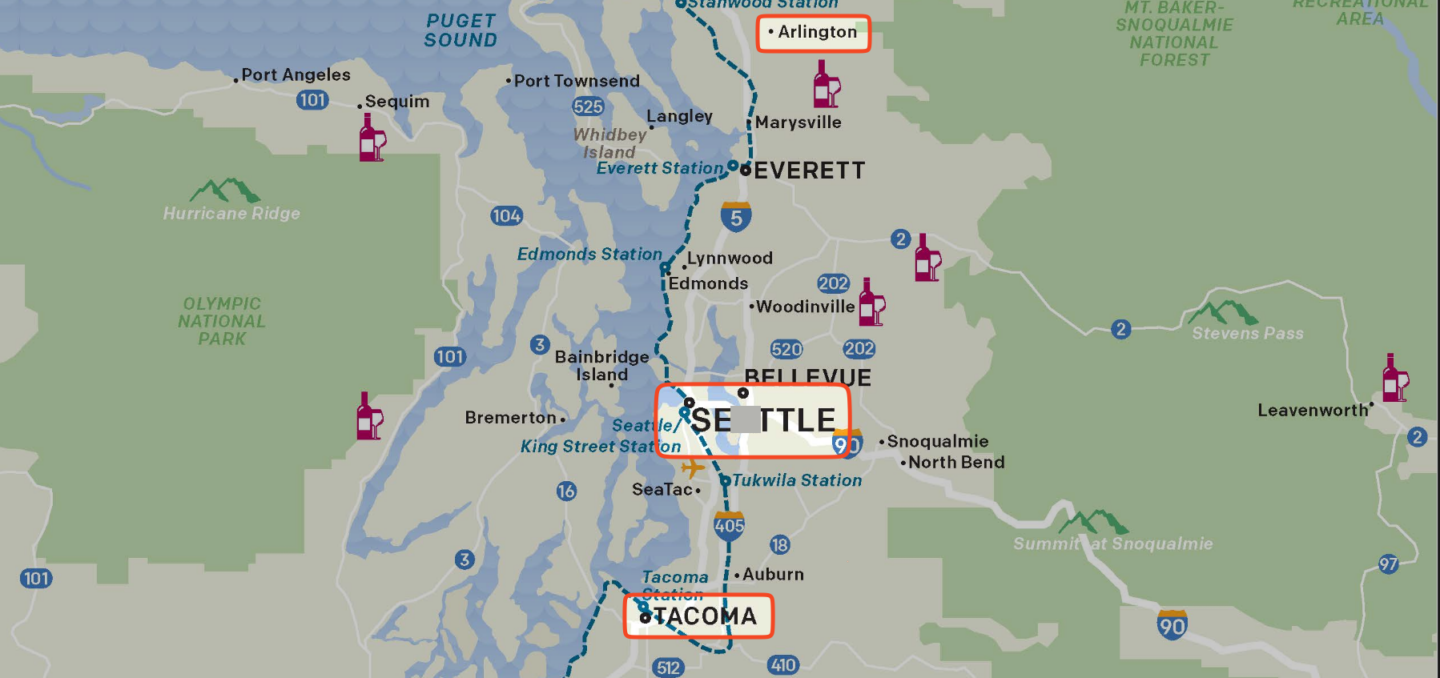
Meet me in Seattle?
If I am in Tacoma and you are in Arlington, it makes sense to meet in Seattle; well it does if you are in Arlington, WA. But what if you are in Arlington Texas, Arlington Virginia or even Arlington Road in London (England)? If you are planning to meet your Opponent somewhere you need to find out where they are.
This is why at SettleIndex we talk about Position not Value. To work out where a dispute might settle, you first have to know where your Opponent is coming from. You and your Opponent always have different Positions, the settlement figure is likely to be a compromise somewhere between the two.
How do you use Bernouilli principles to work out your own Position?
Step 1: Award and Overall Values
A dispute has at least 2 potential Outcomes at trial; win or lose – but generally there are many more permutations to consider. Within one dispute there may be Serial Issues, Serial heads of loss, a broad range of possible award values, contribution issues and caps on recoverability. As well as Claims and Counterclaims, the Tribunal may have discretion to order parties to pay each others’ legal costs.
Our software can extract the relevant data simply from uploaded Claim Documents. We then build for you a Map of all the Outcomes predicated by your data. We also calculate the “Award Value’ for each Outcome; that is the likely amount the Tribunal would order one party to pay the other by way of claims and costs. The term ‘value’ makes sense in the context of individual hypothetical Outcomes, because that would be their actual value if they happened.
As well as an Award Value, each Outcome also has an Overall Value. The Overall Value is simply the Award Value adjusted for the total costs you would have to spend taking a dispute to a hearing. For a Claimant this means the Award Value MINUS their costs. For a Defendant it means the Award Value, PLUS their costs.
Step 2: Award and Overall Positions
We calculate your ‘Award Position’ by risk weighting the Award Values. We do this by compounding the chances of all the contingencies along the path to the Outcome and multiplying the Award Value by that percentage. We add together the risk weighted Award Values to give your Award Position. Your Overall Position is calculated using the same principles. Your Positions are effectively the average value of your dispute at different stages as costs are spent. Calculating these would be an impossible challenge for mental arithmetic.
How does your Position change as you spend your case budget?
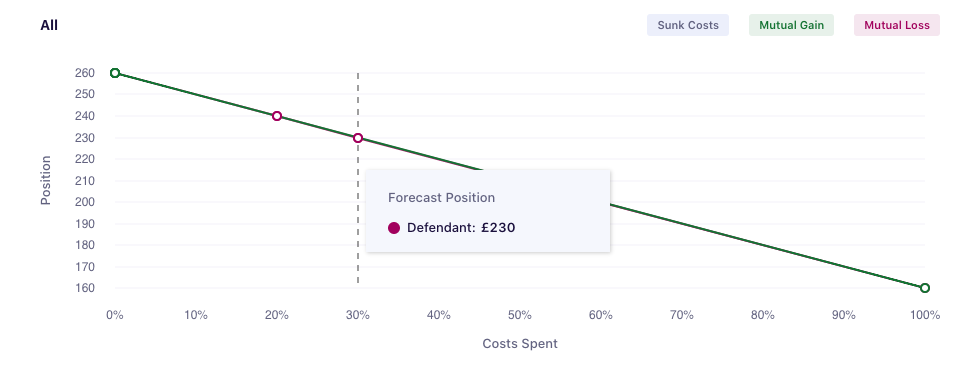
We draw a straight line on our Settle chart between your Overall Position (to the left) and your Award Position (to the right). Your Overall Position is before you have spent any of your case budget; your Award Position is after you have spent all of it. And yes, you guessed correctly, your Current Position is where you have reached on that line taking into account how much of your budget you have spent to date. Your Forecast Position is where you will have reached after spending a specified additional amount of your budget – perhaps the additional costs to get you to mediation.
Below is a Claimant LIne, with dots showing the Current and Forecast Positions:
A Defendant line looks much the same; but where the Claimant line ascends in value, the Defendant line descends.
How interesting would it be to put the two lines together on the same chart?
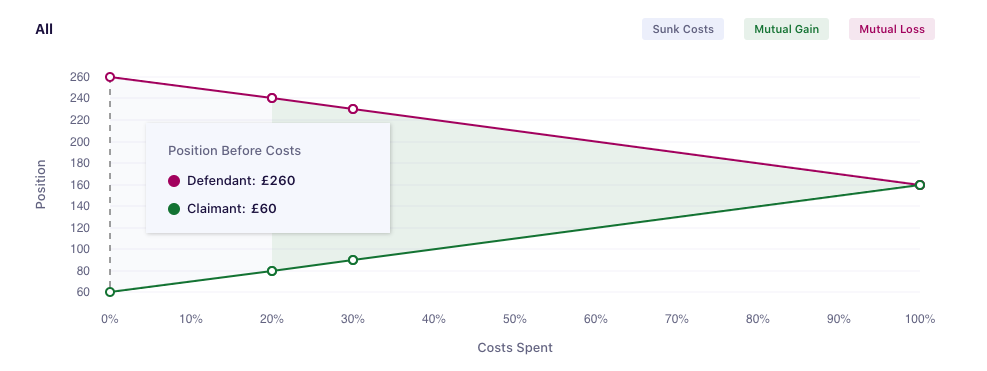
This is a unicorn, you will never see a real case with a chart that looks like this! The parties here have identical budgets (£100) and agree that the Claimant has an 80% chance of recovering £200 at trial. There are no recoverable costs. Even though the parties exactly agree on the Award Position (£160), it would be a mistake for either of them to settle for their Overall Positions. It would however make sense for them to settle for the Award Position, because that is the one point at which their respective Positions coincide.
Opponents would never of course agree on the chances. They might agree on the amount of the Claims Award if it was, say, a simple debt. Let’s imagine however that the Defendants see the merits exactly opposite to the Claimants and give only a 20% chance of the Claimant succeeding. This is what it would look like:
ARLINGTON WA, close together.
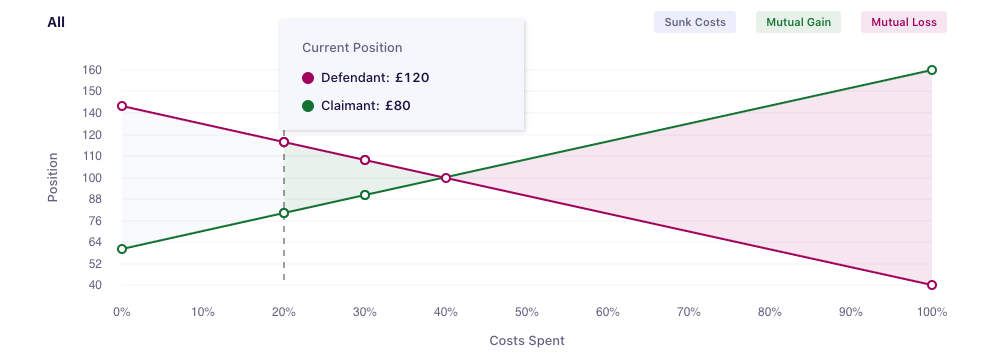
Despite the massive difference of opinion on the merits, the effect of costs means that the parties do have a Shared Position – in this case £100. That figure is higher than the Claimant’s Current Position and lower than the Defendant’s Current Position, so both of them will be better off if they settle at £100. They need to settle soon however, before they end up in the red zone.
The problem, you may ask, is how do you know what your Opponent is thinking? You don’t, but you should make an educated guess. When we create our benchmark valuation, we create an appropriate spread. As this example shows, even where you postulate an improbably big difference in outlook, there is generally a rational settlement to be had – one that is better than your Overall Position at the outset. We create Opponent values for every contingency in the Casebot, so we can calculate both parties’ estimated Positions.
Most commercial disputes follow this pattern, with the Defendant Position starting higher than the Claimant’s and then inverting after a proportion of the case budget has been spent. It is a pretty fundamental ingredient to settling a dispute whether your Opponent’s Current Position is above or below your own. It does happen sometimes (where Cost Budgets are low in proportion to the difference in Award Positions) that the Position lines never cross, so there is no Shared Position.
ARLINGTON ROAD, LONDON, miles apart
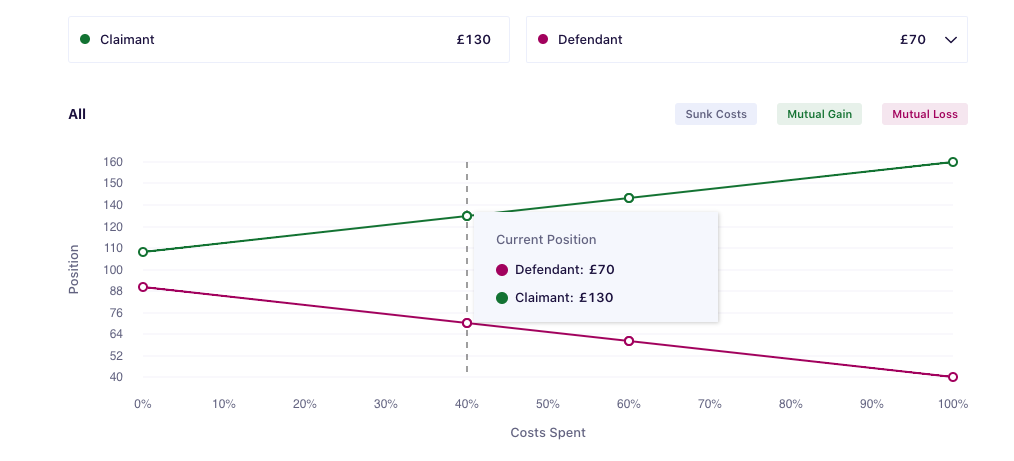
To settle this case at least one party, and likely both, would have to opt for worse than their Current Position, or let the dispute go to trial. We hope this explains why, to understand whether you can settle for more or less than your Current Position, you also have to know your Opponent’s Position!
For more information about the basics of how SettleIndex works, see: